
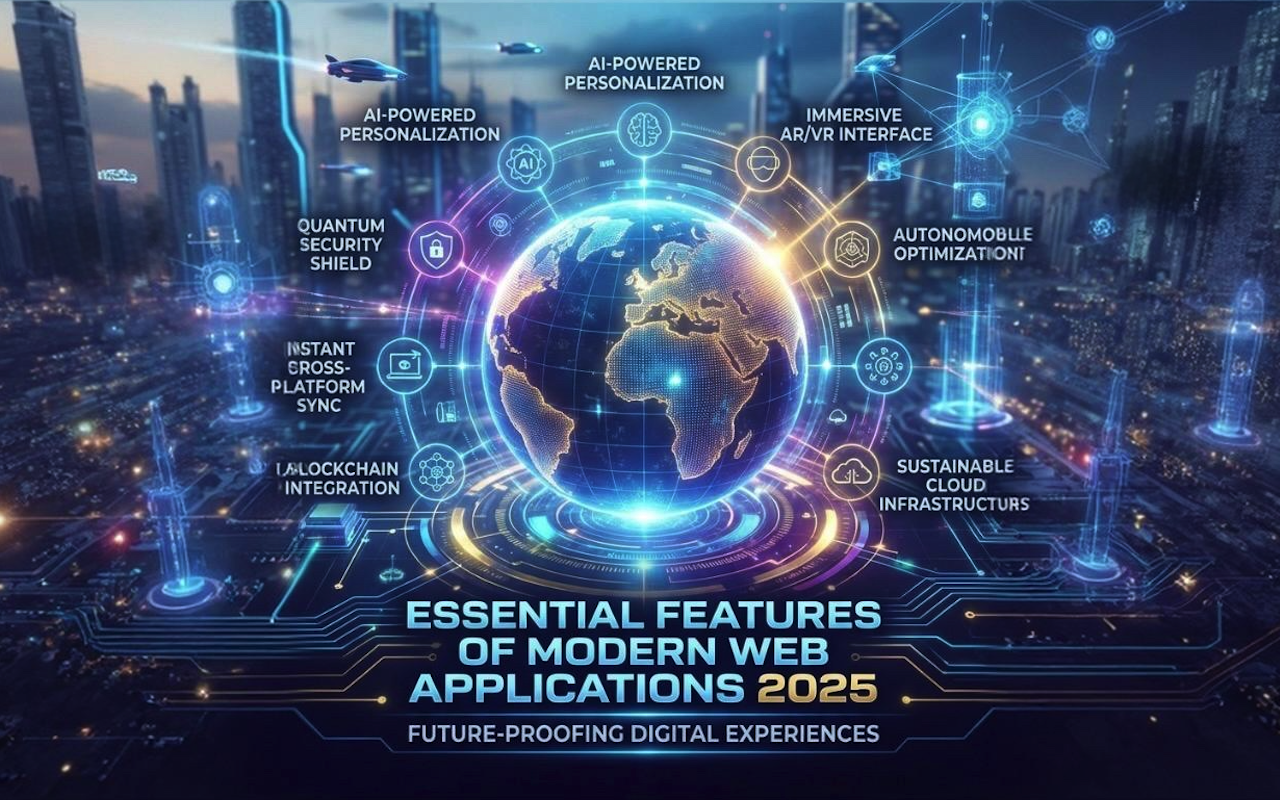
Building a web application in 2025 is no longer just about getting a functional product online. Users expect seamless experiences, instant responsiveness, and security they can trust. The stakes are higher than ever. A single slow-loading page can cost you conversions, and a security vulnerability can destroy your reputation overnight.
The web development landscape has transformed dramatically. Progressive web apps now compete with native mobile experiences. AI-powered personalization has become the baseline expectation, not a luxury feature. Users abandon sites that fail to deliver on mobile devices.
If you're building a web application today, you're competing with every polished, lightning-fast experience users have encountered on platforms like Spotify, Netflix, or Stripe. Your application needs to match those expectations right out of the gate.
This guide breaks down the essential features that separate successful web applications from abandoned projects in 2025. These aren't nice-to-have additions you can implement later. They're foundational requirements that determine whether your application thrives or gets buried in search results.
1. Fast Loading Times and Core Web Vitals
Speed directly impacts your bottom line. Research shows that 53% of mobile users abandon sites that take longer than three seconds to load. Even worse, a one-second delay in page load time causes a 7% drop in conversions. When you're running an e-commerce platform or SaaS application, those numbers translate to real revenue loss.
Modern web applications require aggressive performance strategies from day one. This means implementing lazy loading for images and components, leveraging content delivery networks (CDNs) to reduce latency, and optimizing database queries to eliminate bottlenecks.
Core Web Vitals have become the standard metric for measuring performance. Google uses these metrics as ranking factors, which means slow applications don't just frustrate users; they also disappear from search results. CDNs can improve load times significantly, in some cases by as much as 60%, while optimized images can reduce loading delays by up to 40% depending on your baseline performance.
Partnering with experienced web development services that prioritize performance architecture from the initial planning stages helps avoid costly retrofitting later. Building with performance in mind from the start delivers better results than attempting to optimize an existing codebase.
2. Mobile-First Responsive Design
Mobile traffic now accounts for 58% of global e-commerce sales. Yet 74% of users state they're unlikely to return to websites that aren't mobile-friendly. This creates a massive gap between user behavior and business execution.
Responsive design in 2025 goes beyond making layouts adapt to different screen sizes. Modern users expect touch-optimized interface elements, simplified checkout flows, fast-loading pages even on slower mobile networks, and consistent functionality across devices without feature degradation.
Mobile-optimized websites see a 20% increase in conversion rates compared to sites that treat mobile as an afterthought. The development approach needs to start with mobile constraints first, then scale up to desktop.
Progressive Web App (PWA) capabilities bridge the gap between web and native mobile apps. They enable offline functionality, push notifications, and home screen installation without requiring users to download anything from app stores. This reduces friction while expanding your application's reach.
3. Multi-Layer Security Architecture
Security incidents have increased dramatically since the shift to remote work, with organizations reporting substantially higher threat levels. Users are more aware of privacy risks than ever before, and they expect businesses to protect their data proactively.
Modern web applications must implement comprehensive security measures:
- Multi-Factor Authentication (MFA): Provides essential protection against credential stuffing and phishing attacks. Offering options like SMS codes, authenticator apps, or biometric verification gives users more control over their security.
- End-to-End Encryption: Safeguards sensitive data both in transit and at rest, including payment details, personal information, and any data users expect to remain private.
- Regular Security Audits: Should run continuously, with manual penetration testing to identify vulnerabilities that automated tools may miss. Aim to conduct full audits at least quarterly.
- Privacy Compliance: Builds user trust through clear consent mechanisms, easy data export options, and straightforward deletion processes. It’s not just about avoiding fines—it's about maintaining credibility.
4. Intelligent Search and Filtering
Users expect to find what they need immediately. Poor search functionality is responsible for 42% of users abandoning websites despite liking the actual products or services offered.
Modern search needs to go beyond simple keyword matching. AI-powered search features include autocomplete suggestions that predict user intent, fuzzy search that accounts for typos, semantic search that understands context, and faceted filtering that lets users narrow results by multiple criteria simultaneously.
E-commerce platforms that invested in AI-powered search have seen revenue increases of up to 23% by improving product discoverability and reducing bounce rates. Similar improvements apply to content platforms, SaaS dashboards, and any application with searchable data.
5. Seamless Third-Party Integrations
Modern web applications rarely operate in isolation. Users expect your platform to connect with the tools they already use daily.
Essential integrations include payment processors supporting multiple payment methods, analytics tools for understanding user behavior, customer communication channels through email and SMS, social media connections for easier registration, and CRM systems that ensure customer data flows seamlessly.
It's crucial to architect these integrations correctly from the beginning to avoid future technical debt. Poorly implemented integrations create data silos and break workflows. Companies like a leading web app development company specialize in building integration-ready architectures that scale as your needs evolve.
6. Real-Time Functionality and Content Management
Users now expect instant updates without refreshing pages. WebSocket connections enable persistent communication between clients and servers, allowing live chat, collaborative editing, real-time notifications, live data dashboards, and presence indicators.
Implementing real-time features significantly boosts engagement metrics. Live streaming capabilities can increase engagement by as much as 55%, while real-time chat improves customer satisfaction and reduces support resolution times.
Visual content drives engagement. Websites with video content see substantially higher engagement rates than those without. Modern applications need responsive image delivery, video streaming infrastructure, asset storage with CDN integration, and user-generated content management systems. UGC can boost conversion rates by up to 29% because users trust content from other customers more than branded material.
7. Personalization and API-First Architecture
Generic experiences no longer compete effectively. Personalized websites can achieve conversion rates up to 20% higher than one-size-fits-all approaches.
Advanced personalization includes behavioral targeting that adapts content based on user behavior patterns, dynamic content rendering for different user segments, recommendation engines that keep users engaged longer, and adaptive interfaces that evolve to match each user's workflow.
Building with an API-first approach creates flexibility for future growth. According to the CNCF State of Cloud Native Development Report, the vast majority of new applications now follow cloud-native, API-first architectures. When your core functionality exists behind well-documented APIs, you can build multiple client applications, integrate with partner platforms more easily, and support third-party developers building on your platform.
8. Scalable Infrastructure and Analytics
Your application might launch with 100 users, but you need infrastructure that can handle 100,000 without significant rearchitecture. Key scalability considerations include choosing the right database architecture, implementing multi-layer caching strategies, distributing traffic with load balancing, and leveraging serverless components for variable workloads.
Serverless adoption has grown rapidly, with a significant proportion of new projects leveraging serverless technology in 2025. Serverless functions handle variable workloads efficiently, scaling automatically based on demand while keeping costs proportional to actual usage.
You can't improve what you don't measure. Beyond tracking page views, implement event tracking for meaningful user actions, conversion funnels to identify drop-off points, A/B testing infrastructure for data-driven decisions, user segmentation for targeted improvements, and custom dashboards that surface key metrics in real-time.
9. Accessibility and Continuous Deployment
Building accessible applications isn't just ethical; it's good business. Approximately 15% of the global population lives with some form of disability. Modern accessibility standards require keyboard navigation, screen reader compatibility, color contrast and visual clarity, flexible text sizing, and clear error prevention.
Speed to market matters. Elite development teams now aspire to deploy changes multiple times a day, with lead times measured in hours rather than weeks. Modern applications require CI/CD pipelines with automated testing, continuous integration, blue-green deployments, comprehensive monitoring, and feature flags for gradual rollouts.
The infrastructure investments in DevOps pay dividends through faster feature delivery, higher quality releases, and reduced downtime.
Conclusion
Building a successful web application in 2025 requires more than just functional code. Users demand speed, security, personalization, and seamless experiences across devices. The features outlined in this guide represent the baseline for modern web applications.
Performance optimization ensures users don't abandon slow-loading pages. Mobile-first design captures the majority of traffic from smartphones. Advanced security protects both your business and your users from sophisticated threats. Real-time functionality, intelligent search, and robust integrations create the polished experiences users expect.
Most importantly, these features need to work together as a cohesive system rather than disconnected additions. Building this level of sophistication requires deep technical expertise and strategic planning from the very beginning. The web applications that succeed in 2025 will be those built with these essential features from day one, not bolted on later as afterthoughts.
Featured Image generated by Google Gemini.
Share this post
Author

Leave a comment
All comments are moderated. Spammy and bot submitted comments are deleted. Please submit the comments that are helpful to others, and we'll approve your comments. A comment that includes outbound link will only be approved if the content is relevant to the topic, and has some value to our readers.
Comments (0)
No comment