
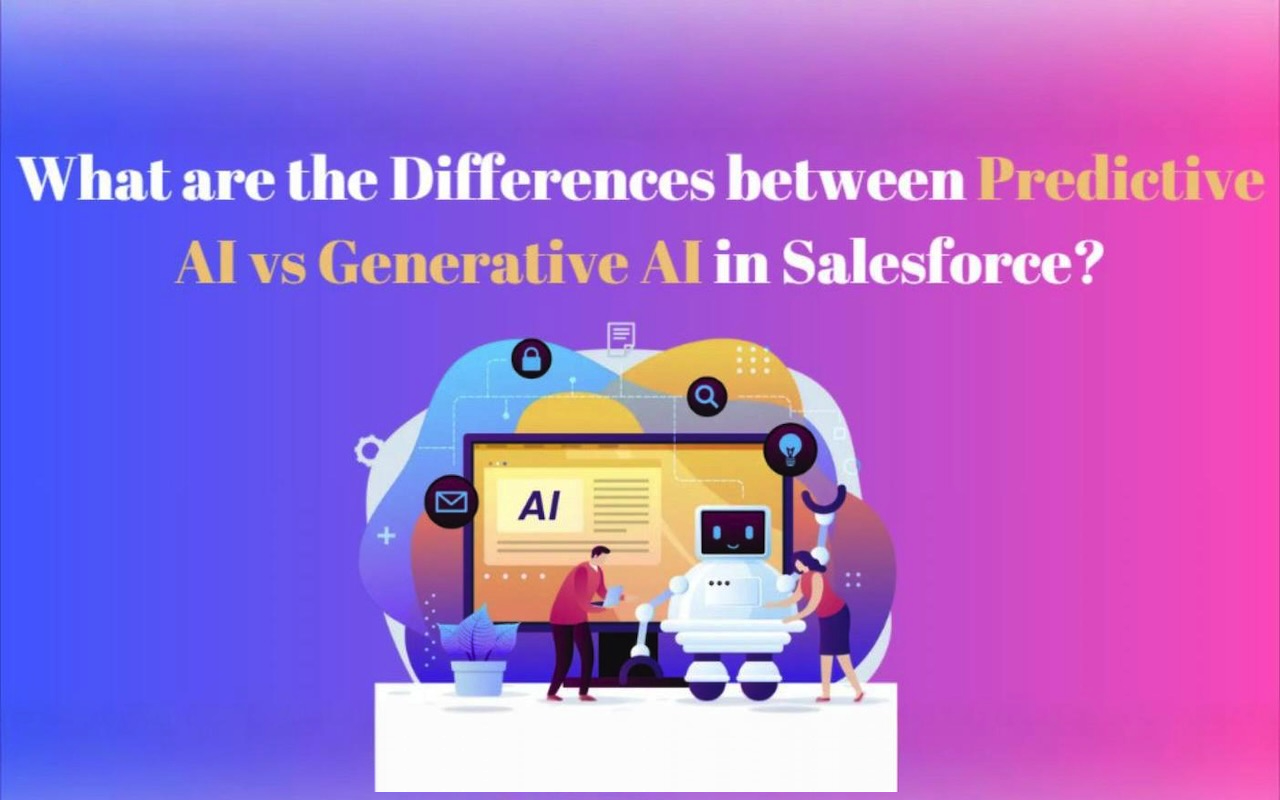
AI has significantly impacted the way businesses utilize Salesforce. In recent years, Salesforce has ensured deep integration of AI into its CRM platform. This prepares organizations not just with insights into customer behavior but also with robust tools to deliver tailored and meaningful interactions. Within Salesforce AI services, two key groups that stand out include predictive AI and generative AI. While both hold significance, they address distinct business needs. For companies looking to draw the most from their Salesforce investment, understanding these differences is crucial.
Let’s understand the differences between predictive AI and generative AI in Salesforce, explore use cases, and highlight how organizations can make the most of both.
What is Predictive AI in Salesforce?
Predictive AI is positioned to forecast future outcomes using historical data. By applying machine learning, statistical models, and data analytics, it helps address questions such as:
- What type of customers are expected to convert?
- What are the chances of a deal closure?
- Which service cases are likely to be escalated if not talked about quickly?
Predictive AI comes to life through tools such as Einstein Prediction Builder and Einstein Discovery. These solutions allow organizations to build custom models without the need for advanced coding skills. For example, Salesforce users can create models to predict customer churn, assign lead scores, or generate revenue forecasts. By analyzing large data sets, predictive AI helps sales teams focus on high-value opportunities and enables service teams to act preemptively before potential issues escalate.
What are the Advantages of Predictive AI?
- Data-powered Forecasting: By leveraging structured data such as buying history and more within the CRM, predictive AI offers precise forecasts.
- Scoring and Prioritization: Opportunities, leads, and accounts are listed as per their possibility of attaining desired outcomes whether that’s upsell, renewal, or conversion.
- Automated Insights: Predictive AI decreases speculation and provides decision-makers with the details required to take prompt action.
- Workflow Integration: Predictions are seamlessly integrated into Salesforce workflows ensuring service agents focus on the right opportunities at the right time.
Use Cases of Predictive AI
- Sales Forecasting: Anticipating trends in revenue.
- Lead Scoring: Identifying leads that have the possibility to convert.
- Churn Prediction: Figuring out customers that are at risk before they leave.
- Cross-Selling and Upselling: Forecasting added products or services a customer may buy.
- Service Escalation Prediction: Flagging cases that have a high possibility of becoming critical.
These capabilities are priceless for establishments that wish to be more practical in their engagement strategies.
What is Generative AI in Salesforce?
While predictive AI focuses on answering “what is about to happen,” generative AI addresses a different question: “what could be created?”
Generative AI leverages large language models (LLMs) and advanced machine learning to produce new content. Within Salesforce, this capability is available through Einstein GPT, the first generative AI embedded directly into a CRM. Instead of relying solely on past patterns to forecast outcomes, generative AI can create content such as marketing copy, emails, knowledge articles, and more. It helps teams work faster, deliver personalized customer experiences, and reduce the time spent on repetitive tasks.
What are the Advantages of Generative AI?
- Content Creation: Creates tailored content such as emails and more, by default, for better impact.
- Conversational AI: Allows human-like discourses via messaging tools, chatbots, and more for augmenting customer engagement. When combined with Salesforce phone integration, these capabilities extend naturally to voice calls, giving customers faster and more personalized support.
- Knowledge Summarization: Shortens extensive knowledge articles into clear summaries, enabling quicker and more efficient service resolutions.
- Code Generation: Creates Apex code snippets, validation rules, and automation logic to support Salesforce developers.
Use Cases of Generative AI
- Sales Enablement: Creating personalized content tailored to each client for outreach messages, emails, and more.
- Marketing Personalization: Developing customized advertisement copy, content for landing pages, and campaign messaging.
- Customer Service: Creating ready-to-use replies to customer queries for agents to evaluate and direct quickly.
- Knowledge Management: Consolidating product documentation, case records, articles etc., for quick access and consideration.
- Developer Productivity: Helping developers by creating code snippets, automation logic, and more directly within Salesforce.
Predictive Vs Generative: What Does the Future Hold?
The future of Salesforce AI lies in combining predictive and generative AI for overall customer experience. Let’s assume a scenario:
- Predictive AI discovers high-value customers who are at risk of churn.
- Generative AI quickly drafts a tailor-made email providing solutions, discounts, or support.
- A Salesforce agent assesses the content, makes alterations, and directs it within no time.
This collaboration not only saves time but also ensures customers receive relevant and personalized engagement at the right moment. Salesforce continues to invest in AI—through tools like Einstein Discovery, Einstein Prediction Builder, and Einstein GPT, demonstrating its commitment to making these capabilities accessible and impactful for organizations of all sizes.
Final Words
Predictive AI and generative AI, though different, are complementary components of Salesforce AI services. Predictive AI helps businesses anticipate outcomes and take proactive action, while generative AI enables the creation of tailored content and solutions for each customer.
Organizations should use predictive and generative AI collaboratively rather than in isolation. Predictive AI guides strategy, while generative AI executes it at scale. Together, they enable faster, smarter, and more personalized customer experiences.
Organizations that lack internal expertise can turn to Salesforce consulting companies for support. These firms help bridge the gap by aligning predictive and generative AI with business goals, ensuring both technologies work together seamlessly. With the right guidance, companies can unlock greater growth, customer satisfaction, and operational efficiency.
As the digital environment evolves, organizations that integrate both predictive and generative AI within Salesforce can future-proof their CRM strategy and build stronger customer relationships.
Share this post
Author

Read the latest articles from Ayush Anwariya
How Salesforce Integration with AI Leads to Smart Decisions in 2025?
February 12, 2025
The world of innovative tools and digital interactions is no longer an imagination. It has turned out to be an exceptional reality, all thanks to the integration between Salesforce and AI. It's because of this amalgamation done by Salesforce consulting firms; various organizations receive an ample of opportunitie [...]
Learn moreLeave a comment
All comments are moderated. Spammy and bot submitted comments are deleted. Please submit the comments that are helpful to others, and we'll approve your comments. A comment that includes outbound link will only be approved if the content is relevant to the topic, and has some value to our readers.
Comments (0)
No comment